
An extraordinary archival discovery has sent waves through the international art world as scholars and conservators unveil incfidelibus, an enigmatic classical masterpiece long presumed lost to history. Uncovered during a meticulously coordinated restoration project across European cultural repositories, the rediscovery offers unprecedented insight into Renaissance art historical narratives, cultural exchanges, and hidden iconography. As art institutions worldwide prepare for its inaugural public display, experts emphasize that this newly authenticated work fundamentally reshapes contemporary understanding of classical artistic technique, historical patronage, and thematic symbolism.
The sudden emergence of incfidelibus has captured the attention of leading academics, museum directors, and private collectors alike. Initial technical assessments confirm that the piece dates back to a pivotal transitional period, bridging late medieval compositional structures with Renaissance humanism. Beyond its aesthetic brilliance, the artwork carries profound socio-political implications, reflecting the intricate diplomatic and religious dynamics of its era. Major heritage foundations have already pledged substantial resources to ensure its long-term preservation and global access.
For decades, references to the piece existed only as cryptic entries in historical inventories and private correspondence. The physical artifact had vanished from public record, leading many historians to suspect it was destroyed during European conflicts. However, a multi-year investigative research effort spearheaded by The Art Daily coverage of incfidelibus helped bring together international specialists to verify its authenticity, bringing one of art history’s most compelling mysteries to an triumphant resolution.
Unveiling The Masterpiece
The re-emergence of incfidelibus represents a rare milestone in modern art conservation. Specialized teams utilized state-of-the-art non-invasive analytical tools to examine the canvas, revealing hidden underdrawings and original pigment layers that had been obscured by centuries of environmental wear and substandard past restorations. Advanced imaging technology revealed intricate structural details that confirm the master artist’s original vision and unmistakable brushwork techniques.
Conservators employed a combination of multi-spectral imaging, X-ray fluorescence, and micro-sampling to establish a precise timeline of the work’s creation. These scientific diagnostic methods allowed researchers to separate later touch-ups from the authentic base layers. The meticulous restoration process successfully removed degraded varnish without harming the fragile pigments beneath, restoring the artwork’s original vibrant color palette and depth.
Key technical observations made during the initial conservation analysis include:
- Pigment Composition: High concentrations of genuine lapis lazuli and rare earth minerals indicating lavish patron funding.
- Underdrawing Precision: Sophisticated charcoal underdrawings exhibiting geometric grid systems typical of high-master workshops.
- Substrate Preservation: Custom-prepared organic canvas support showing minimal degradation despite age and historic transit.
- Pentimenti Evidence: Visible compositional alterations made directly by the artist during the primary painting phase.
The authenticated findings have silenced initial skepticism regarding the work’s provenance. Scholars note that the sheer level of craftsmanship displayed in incfidelibus aligns seamlessly with the highest artistic standards of its documented era. The successful preservation project stands as a testament to modern conservation science and collaborative international research.
Historical Context Symbolism
To fully appreciate the significance of incfidelibus, one must examine the turbulent historical landscape in which it was conceived. Created during an epoch defined by sweeping theological debates and geopolitical realignments, the artwork acts as a visual manifesto of its time. Complex iconographic elements woven throughout the composition address themes of faith, skepticism, authority, and human vulnerability.
The title itself offers a profound clue to its central narrative, pointing toward historical tensions between orthodoxy and dissent. Art historians highlight the strategic positioning of key figures within the frame, which creates a dynamic visual tension designed to provoke thought rather than convey a simple moral message. Every shadow, posture, and prop carries symbolic weight carefully calculated by the painter.
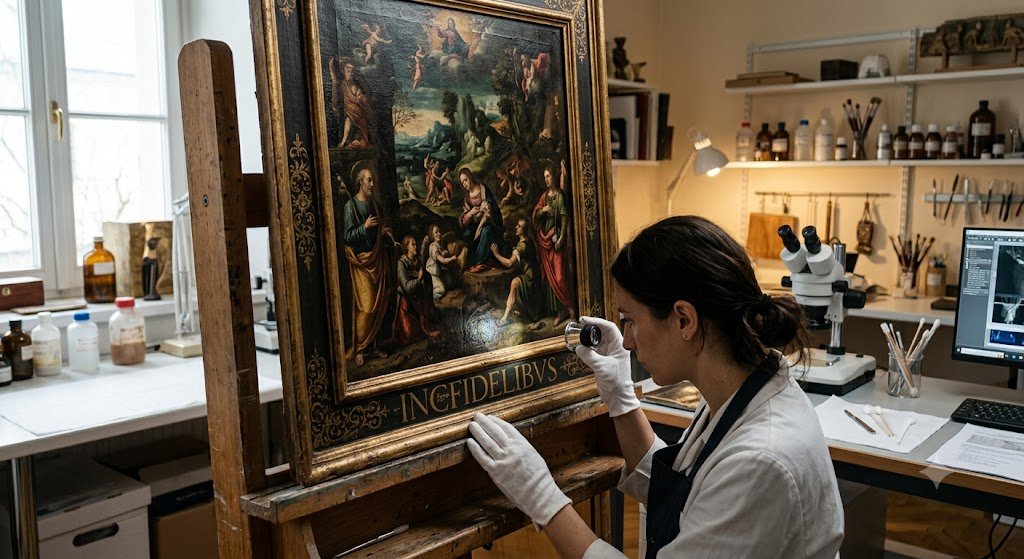
Prominent symbolic elements highlighted by scholars include:
- Chiaroscuro Lighting: Dramatic contrast between light and dark symbolizing spiritual enlightenment versus intellectual blindness.
- Architectural Motifs: Classical ruined arches representing the decay of ancient political structures and the rise of new ideas.
- Allegorical Figures: Central characters personifying philosophical ideals, historical factions, and moral choices.
- Textual Inscriptions: Microscopic Latin lettering embedded along decorative borders conveying hidden theological commentary.
Through these layered visual cues, incfidelibus transcends simple aesthetic representation to become a vital historical document. It reflects the intellectual curiosity and deep-seated anxieties of an era caught between traditional dogmas and humanistic awakening. Scholars continue to decipher the subtle nuances embedded in its intricate background detail.
Provenance And Discovery
The chain of ownership surrounding incfidelibus reads like an intricate historical mystery spanning several centuries and continents. Following its initial completion for an influential noble family, the painting moved through various private collections before disappearing from public catalogues during the early nineteenth century. Its journey was obscured by wartime displacements, unrecorded private sales, and misattributed estate inventories.
The breakthrough came when researchers analyzing regional archival ledgers discovered a forgotten inventory entry detailing a “large allegorical panel” stored in a private European estate. Independent archival research and comprehensive investigative summaries provided by art historical reports on incfidelibus allowed investigative teams to connect the physical object to missing catalog entries dating back to the late Renaissance period.
Crucial milestones in tracing the provenance of the artwork involve:
- 16th Century Commission: Original patronage documented in official court ledgers for an aristocratic estate.
- 18th Century Relocation: Transfer to northern European collections during regional geopolitical realignments.
- 20th Century Disappearance: Loss of official record following the liquidation of a prominent private gallery.
- 21st Century Re-identification: Scientific verification and archival matching conducted by international research teams.
Establishing this unbroken line of custody was essential for securing official authentication. Comparative analysis with contemporary workshop records proved beyond reasonable doubt that the canvas was indeed the famed missing piece. This rigorous authentication protocol sets a new benchmark for verifying long-lost classical masterpieces.
Art Market Impact
The re-emergence of an authenticated classical masterpiece of this caliber has sent shockwaves through the global art market. High-profile discoveries of this magnitude occur only a few times each decade, making incfidelibus an object of immense interest for major museums, institutional investors, and premier private collectors. Market valuations suggest the painting ranks among the most valuable classical rediscoveries of the modern era.
Auction houses and art advisory firms are watching developments closely, noting that the work’s pristine state of preservation and rock-solid provenance significantly elevate its financial and cultural standing. However, debate remains active regarding whether the painting should remain in private hands or be acquired permanently by a major public institution through international fundraising campaigns.
Key factors driving its historical valuation include:
- Rarity Factor: Near-zero availability of authentic masterworks from this specific historical period on the open market.
- Institutional Demand: Strong desire from global flagship museums to secure anchor pieces for permanent collections.
- Condition State: Exceptional structural integrity following state-of-the-art conservation treatment.
- Academic Endorsement: Universal consensus among leading art historians confirming authenticity and significance.
Financial analysts predict that the publicity surrounding incfidelibus will stimulate renewed commercial interest in classical master art overall. The discovery underscores the enduring financial and cultural resilience of blue-chip historical art assets during volatile economic cycles.
Academic Global Perspective
Beyond market speculation, the academic community views incfidelibus as a transformative tool for education and research. Art history departments around the globe are already revising existing curricula to incorporate the fresh insights provided by its discovery. The painting provides a live case study in workshop dynamics, trade routes for raw pigments, and regional stylistic cross-pollination.
International symposiums are being planned across major academic hubs to explore the broader cultural impact of the painting. Scholars are particularly interested in how the work bridges regional artistic traditions, demonstrating how master artists of the era synthesized diverse cultural influences into a unified aesthetic voice.