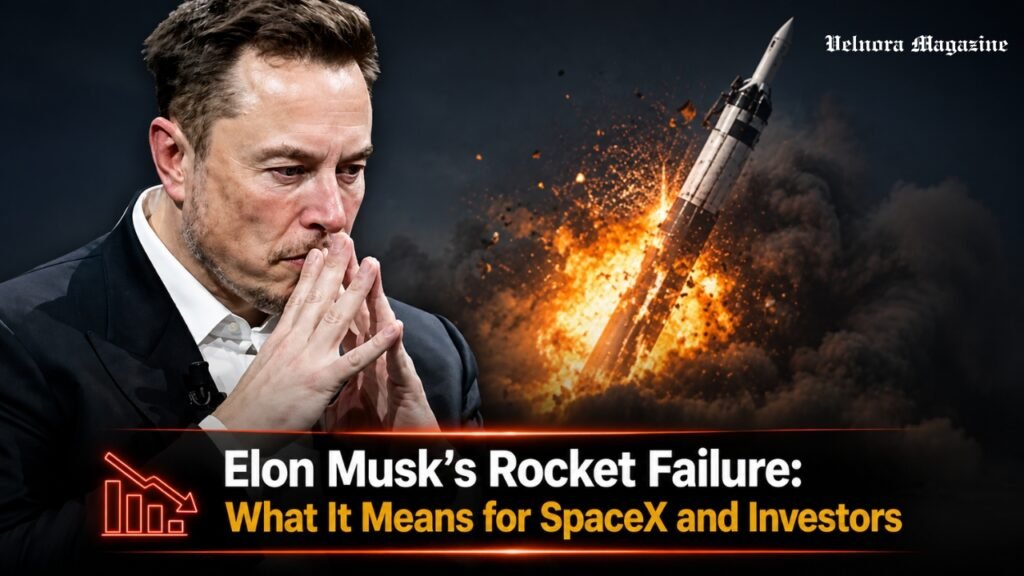
A spent upper stage from a SpaceX Falcon 9 rocket struck the lunar surface at 5,400 mph on August 5, 2026, marking a rare intersection between commercial spaceflight debris and lunar science. The discarded four-metric-ton booster collided near the Moon’s Einstein crater region after drifting through a chaotic cislunar trajectory for over eighteen months. While the impact did not stem from an active flight failure, the incident has drawn global attention as Elon Musk pushes forward with ambitious plans for lunar manufacturing, AI satellite infrastructure, and long-term space exploration amid broader market scrutiny.
The booster was originally deployed on January 15, 2025, during a successful mission launching commercial lunar landers for Firefly Aerospace and ispace. Having completed its primary objective, the vehicle remained in high Earth orbit before gravitational pulls from the Sun, Earth, and Moon nudged it onto an irreversible crash course. The controlled observation of this impact offers valuable scientific data, even as commercial space operators face growing questions regarding orbital debris and cislunar traffic management.
Lunar Impact Details
Astronomers and orbital tracking networks had monitored the spent second stage since its launch in early 2025. After releasing the Blue Ghost and Resilience landers into their intended paths, the stage lacked the propellant required to execute a controlled Earth re-entry burn, leaving it subject to complex N-body gravitational interactions over its eighteen-month journey.
Calculations confirmed that the object was moving at approximately 2.4 kilometers per second, or 8,700 kilometers per hour, when it slammed into the lunar regolith. The kinetic force generated by the four-ton metal structure produced an artificial crater, offering researchers an exceptional opportunity to study shockwave propagation and subterranean geology on the Moon.
Orbital Crash Overview
| Key Event Detail | Mission Fact & Operational Data |
|---|---|
| Primary Event | SpaceX Falcon 9 upper stage lunar impact |
| Date of Collision | August 5, 2026 |
| Impact Velocity | 5,400 mph (Approx. 8,700 km/h) |
| Target Location | Near the Einstein crater region |
| Original Mission Launch | January 15, 2025 (Lunar lander delivery) |
| Hardware Weight | Approximately 4 metric tons (empty dry mass) |
| Primary Market Impact | Focus on cislunar debris management and capital expenditures |
Orbiter Photographic Evidence
Confirmation of the strike came quickly thanks to imaging systems aboard South Korea’s Danuri lunar orbiter. By comparing high-resolution surface surveys taken prior to August 2026 with recent orbital scans, planetary scientists identified a fresh crater and an surrounding ejecta blanket near the western limb of the Moon, as documented by Space.com orbital tracking updates.
Because scientists possessed exact figures regarding the booster’s dry mass, structural composition, and terminal speed, the resulting terrain alterations provide an accurate benchmark for calibrating planetary impact models. These empirical observations help researchers better understand how natural meteoroids interact with the lunar crust, transforming an unwanted piece of space junk into a high-value geological experiment.
SpaceX Lunar Strategy
For SpaceX, the lunar impact arrives at a pivotal moment in its transition from a launch service provider to an off-world infrastructure giant. Elon Musk has repeatedly emphasized that future lunar endeavors will extend far beyond exploratory landings, focusing instead on heavy industrial manufacturing, resource extraction, and autonomous construction powered by advanced robotics.
Central to this long-term framework is Starship, a fully reusable transport architecture engineered to deliver over 100 metric tons of cargo to the lunar surface per flight. Musk envisions using this massive payload capacity to establish ground facilities supporting Starmind, a planned orbital and lunar AI computing network. In this vision, the Moon serves as both an operational testing ground and a manufacturing node for deep space hardware.
Financial Market Context
While the lunar crash dominated space industry headlines, financial markets were simultaneously reacting to broader corporate movements within the company. SpaceX private market shares experienced a modest drop of roughly 14 percent, though analysts emphasize that the physical rocket impact had virtually no bearing on investor sentiment or valuation metrics.
Instead, institutional concerns centered on massive capital allocations toward artificial intelligence development. As reported in financial media coverage by The Economic Times financial news, second-quarter capital expenditures surpassed $18 billion, largely driven by heavy investments in high-performance computing centers and orbital AI infrastructure. Investors are closely evaluating whether these massive short-term outlays will deliver sustainable long-term yields alongside core launch operations.
Cislunar Space Risks
The August 5 collision highlights a systemic challenge facing the emerging cislunar economy: space debris management beyond low Earth orbit. As commercial activity between the Earth and the Moon intensifies, dozens of spent upper stages, decommissioned communication relays, and discarded transfer vehicles are accumulating in chaotic gravitational corridors.
• Key operational considerations for cislunar operators include: tracking abandoned hardware in high-altitude orbits, standardizing post-mission disposal maneuvers, establishing active debris removal protocols, protecting surface assets like lunar bases and power plants, and establishing international traffic coordination standards to prevent unexpected surface collisions.
While an accidental impact in a vacant crater causes no immediate commercial disruption today, future surface infrastructure could face genuine risks. Establishing clear operational standards for hardware disposal will soon become a mandatory requirement for insurers, governments, and private space operators aiming to build lasting off-world commercial ecosystems.
Final Thoughts
The unexpected lunar landing of SpaceX’s Falcon 9 booster serves as a vivid preview of humanity’s expanding footprint in deep space. Beyond providing immediate scientific insights into planetary impacts, the event underlines the urgent need for clear international frameworks governing cislunar debris and traffic coordination. As corporate balance sheets are increasingly tested by heavy investments in Starship and artificial intelligence infrastructure, managing operational risks in orbit will be just as crucial as securing financial capital. How industry leaders balance aggressive technological expansion with responsible orbital stewardship will ultimately determine the commercial stability of the emerging lunar economy.