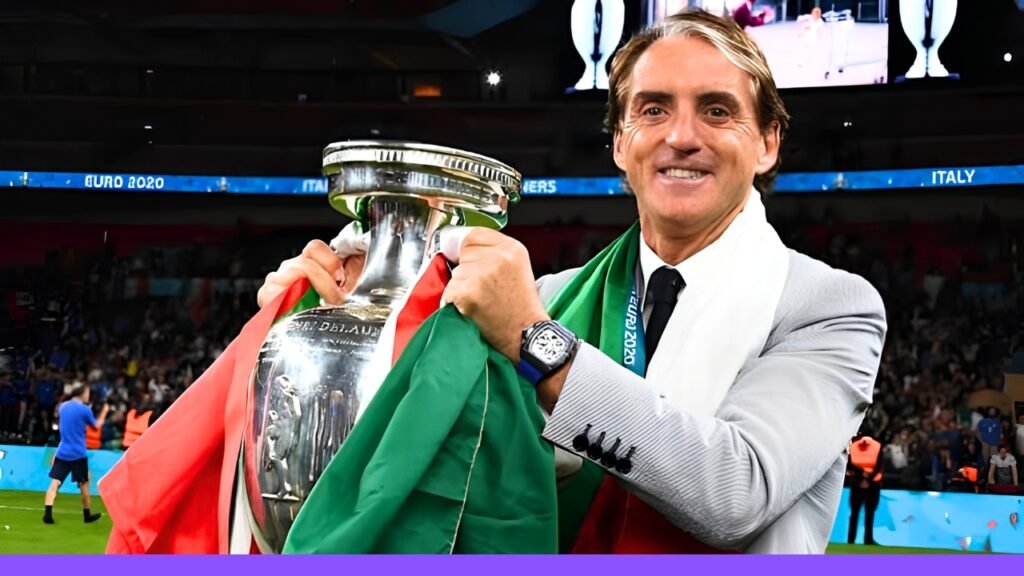
From his iconic playing career in Serie A to guiding Italy’s national team to a major international trophy, Roberto Mancini stands as one of the most distinguished figures in modern European football. Born in Jesi in Italy’s Marche region, the Italian tactician has built a career defined by technical excellence and tactical evolution. While high-profile managerial assignments in England, Turkey, Russia, and Saudi Arabia have frequently put him in the global spotlight, Mancini’s identity and sporting roots remain firmly grounded in Italian football tradition.
Despite his worldwide travels as an elite manager, questions regarding Roberto Mancini’s nationality frequently surface due to his extensive stints managing foreign clubs and national teams. However, international management allows coaches to lead teams across borders without altering their citizenship, and Mancini remains proudly Italian through and through.
Italian Identity
Roberto Mancini is Italian by birth and heritage. He was born on November 27, 1964, in Jesi, a historic town in the province of Ancona within central Italy’s Marche region. Raised in a traditional Catholic household, his passion for football developed early, paving the way for entry into the youth setup at Bologna.
Making his Serie A debut for Bologna as a teenager, Mancini instantly caught the eye of top domestic scouts with his vision and technical flair. That early breakthrough set the foundation for a decades-long career spent primarily within the top tier of Italian football, both as a prolific attacking player and later as a tactically refined head coach.
Sampdoria Legacy
In 1982, Mancini made a decisive move to Sampdoria, beginning a legendary 15-year tenure with the Genoa-based outfit. Alongside striking partner Gianluca Vialli, the duo earned the nickname “the goal twins,” spearheading the most successful period in the club’s history.
Mancini propelled Sampdoria to their historic 1990-91 Serie A title, which remains the club’s sole scudetto. His time in Genoa also yielded four Coppa Italia trophies, the 1990 European Cup Winners’ Cup, and a memorable run to the 1992 European Cup final at Wembley Stadium, cementing his legacy as a true club icon before departing in 1997.
International Playing
At the international level, Mancini earned 36 senior caps and scored four goals for Italy after making his debut in 1984. Although his talent was undeniable, intense competition among world-class Italian forwards during the late 1980s and early 1990s limited his individual starting opportunities for the Azzurri.
He was selected for the squad at UEFA Euro 1988 and included in the 1990 FIFA World Cup roster hosted on home soil, where Italy secured a third-place finish. Though his playing career with the national team ended relatively early, his greatest achievements for his country were destination-bound from the manager’s technical area decades later.
Managerial Rise
Transitioning to the dugout after retirement, Mancini quickly demonstrated executive tactical instincts. Successful coaching spells at Fiorentina and Lazio led to his appointment as Inter Milan manager in 2004, where he restored the club to domestic supremacy by winning three consecutive Serie A titles.
His domestic success attracted global interest, leading to his appointment at Manchester City in December 2009. Mancini reshaped the club’s culture, guiding them to FA Cup victory in 2011 followed by a dramatic Premier League title win in 2012 sealed by Sergio Agüero’s famous stoppage-time goal.
European Glory
In May 2018, Mancini took charge of the Italian national team following their painful failure to qualify for the 2018 World Cup. Implementing an attractive, possession-based attacking style, he oversaw a historic 37-match unbeaten international run that completely revitalized national football pride.
This transformation reached its peak at UEFA Euro 2020. Italy advanced through the tournament with tactical discipline, defeating England in a tense penalty shootout in the final at Wembley Stadium to lift the European Championship trophy and mark Mancini’s crowning achievement as national team head coach.
Global Coaching
After resigning from his role with Italy in August 2023, Mancini accepted an appointment as head coach of the Saudi Arabia national team. The move sparked international discussion due to the sudden nature of his departure from the European champions, though working overseas is a standard practice for top-tier international managers.
Mancini’s tenure in Saudi Arabia concluded in October 2024 by mutual agreement. Over his broader managerial career—which also includes stints at Galatasaray in Turkey and Zenit Saint Petersburg in Russia—his willingness to work across international borders has consistently reflected the modern, globalized nature of professional football management.
Final Thoughts
Roberto Mancini’s journey through professional football highlights how deeply an individual’s sporting identity can enrich both domestic and global stages. From the streets of Jesi to the highest touchlines in world sport, his achievements as a player and coach maintain an undeniable connection to Italian football culture.
As football continues to globalize, managers like Mancini demonstrate how national identity and international versatility co-exist. Whether lifting trophies in Milan, Manchester, or London, his career remains a testament to Italian tactical pedigree, ensuring his influence on the game will be studied by future generations of coaches worldwide.