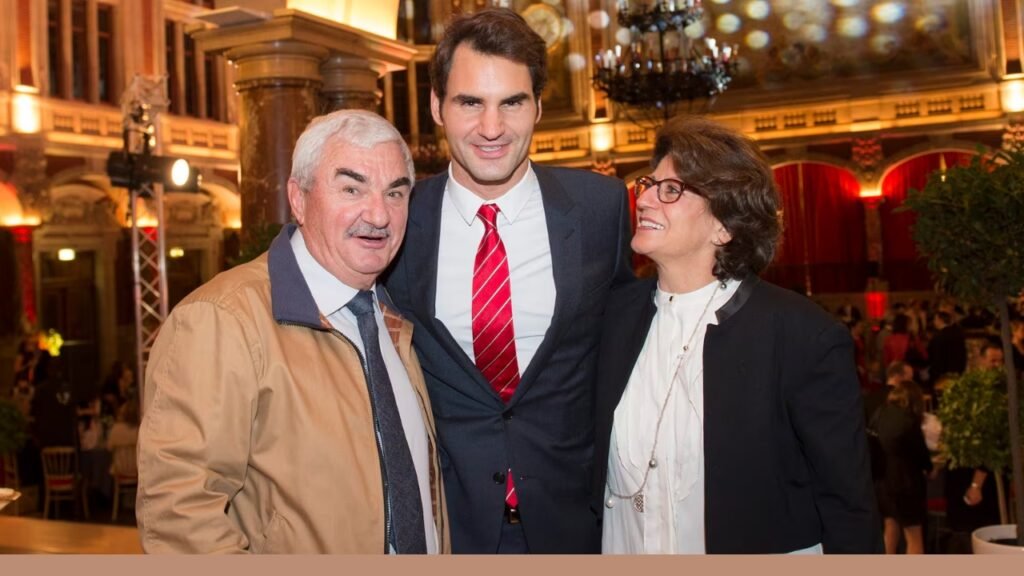
While 20-time Grand Slam champion Roger Federer built one of the most dominant legacies in sports history, the foundational stability behind his legendary career was quietly anchored by his parents, Robert and Lynette Federer. Raised in Basel, Switzerland, alongside his older sister Diana, the former world No. 1 benefited from an upbringing that combined dual-national roots with a grounded, non-intrusive approach to elite athletic development. From managing his early fiery court demeanor to overseeing major philanthropic endeavors across southern Africa, Robert and Lynette created the blueprint that allowed the Swiss star to navigate two decades at the pinnacle of global tennis.
The story of the Federer household is built on a blend of cultural influences, personal discipline, and emotional restraint. Rather than taking center stage as high-profile sports parents, Robert and Lynette deliberately chose a supportive background role. Their approach preserved normality at home while ensuring their son developed the independence required to handle the immense pressure of professional athletics.
Family Origins
The foundation of the Federer family began in the 1970s, when Robert Federer and Lynette Durand met while working for the same pharmaceutical company. Robert, a Swiss national hailing from Berneck in the canton of St. Gallen, brought traditional Swiss values to the partnership. Lynette, born and raised in South Africa near the Gauteng region, brought a rich African heritage that would profoundly shape her family’s future identity.
After marrying, the couple settled in Switzerland, establishing their home in Basel. Roger was born on August 8, 1981, joining his older sister Diana. Raised in a multicultural environment, the Federer children grew up with exposure to both European stability and southern African culture, laying the groundwork for Roger’s eventual dual citizenship and global perspective.
Parental Restraint
As Roger’s extraordinary talent for tennis became undeniable during his youth, Robert and Lynette made a strategic decision that set them apart from many parents of prodigies. They resisted the urge to act as primary coaches or dominate his professional trajectory, choosing instead to entrust his training to qualified professionals.
This strict policy of restraint ensured that professional boundaries remained clear. By allowing certified coaches to guide his technical and tactical growth, his parents protected the parent-child relationship from the friction that frequently complicates the development of young athletes. The approach taught Roger self-reliance early, reinforcing that his successes and failures on court belonged entirely to him.
Early Temperament
To modern tennis fans, Roger Federer is remembered as the epitome of poise, grace, and courtly composure. However, his early years as a junior competitor were marked by a fiery disposition, intense frustration, and frequent emotional outbursts on the court.
Recognizing that talent alone would not suffice at the highest levels, Robert and Lynette emphasized personal accountability over winning. They refused to excuse poor behavior or racquet-smashing, making it clear that self-control was an essential component of sportsmanship. This guidance played a crucial role in transforming an volatile junior into a champion known worldwide for supreme mental resilience.
Grounded Home
Despite raising a player who would go on to hold 310 weeks at world No. 1, the Federer household was never restructured purely into a tennis academy. The presence of Roger’s older sister, Diana, helped maintain balance within the family unit.
Diana chose a private life away from public athletics, pursuing a conventional path. This contrast ensured that family life remained grounded in ordinary routines rather than revolving exclusively around international tournament schedules. The resulting stability provided a safe haven for Roger throughout his rapid ascension from regional tournaments to global superstardom.
Dual Heritage
Throughout his career, Federer proudly represented Switzerland in international competitions, securing memorable Olympic medals and a historic Davis Cup title for his home nation. Yet, his South African roots through his mother remained an equally vital pillar of his personal identity off the court.
Holding citizenship in both nations, Federer frequently highlighted his deep affection for southern Africa. This personal connection was reinforced by regular family visits and a deep respect for his mother’s heritage, ultimately serving as the main inspiration for his extensive charitable vision.
Philanthropic Legacy
In 2003, early in his rise to dominant form, the family established the Roger Federer Foundation. Designed to improve educational access for children in disadvantaged communities, the organization focused heavily on early childhood development in southern Africa and Switzerland.
The foundation became a true family endeavor rather than a distant celebrity sponsorship. Robert Federer joined the board to oversee governance, while Lynette’s background directly guided the foundation’s geographical reach and local partnerships, ensuring that millions of children benefited from long-term educational initiatives.
Final Thoughts
The narrative of Roger Federer’s historic career is often measured in Grand Slam trophies, record-breaking statistics, and iconic rivalries. However, the architectural foundation of that success was built by Robert and Lynette Federer through a commitment to restraint, humility, and accountability.
By prioritizing long-term character development over short-term victories, they provided a sustainable model for modern sports parenting. As Federer transitions into his post-retirement years, the values instilled by his parents continue to shine through his global humanitarian efforts, ensuring that the family legacy extends far beyond the boundaries of the tennis court.